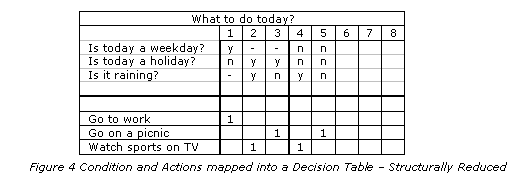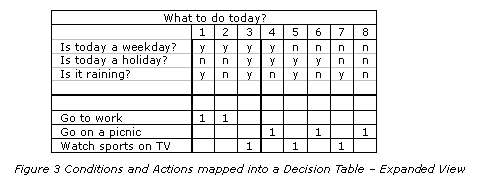
This decision table can be simplified and made smaller without losing any logic content. Certain condition entries can be replaced with dashes to reduce the number of entries. A dash means that the condition entry is ignored - we "don't care" if the value is y or n. Rules with dashes are called complex rules because each such rule actually represents more than one simple rule.
For example, the 1st and 2nd rules shown in can be reduced into one complex rule. They can form one complex rule because they have the same action and differ by only one condition entry. Two additional rule pairs can be reduced into a single complex rule: the 3rd and 5th, and the 4th and 6th rules.
The following decision illustrates this example using complex rules. It captures the same logic that is shown in Figure 3 but in a simplified view. In this case, reducing the table eliminated nearly 50% of the rules. The 1st rule is read as follows:
IF today is a weekday (yes) AND today is a holiday (no) THEN go to work.